Tuesday, April 18, 2017

Appreciate the Unexpected Delights

Check out the pink blanket in our formal Living Room!
The other day I was walking through my home when I discovered an unexpected delight in our formal living room. My youngest daughter (age 3) had hidden her pink blanket behind our sofa, in a place that would not be noticeable unless walking in from a certain angle.
I had to smile - these are the days that will be over in no time at all, as our children grow up and no longer have pink blankets, let alone hide them in the areas of the house we *try* to keep clutter-free.
Thinking it over for a few days now, it seems that there are unexpected delights to be appreciated in many aspects of life, including the workplace. Does your office have a shower, for example? Could you go for a walk or run at lunch and still be ready to face the afternoon? Do people bring in food to share, or bring in a cake to celebrate all birthdays that month? Does your boss let you work off energy with manual dexterity toys placed on conference room tables? Do they hang Super Hero signs in the bathrooms? What about a company "happy hour" once a week, complete with company-paid Uber/Lyft/taxi drivers to take people home? Does your company allow employees to bring their pets to work? Do they hold Safety Appreciation Lunches? Free gourmet coffee? Bike racks in the office? Wireless speakers to allow music to port around the building for office parties? A driving range on the roof? Live band during the annual company picnic? Garden space on campus? A fitness center? Yoga class? Pizza Fridays? Paid sabbaticals (and decorated office space upon return)?
Some of these delights are extremely unexpected (golf on the roof?), but each example is one that I have seen somewhere in my career. Still, unexpected delights don't have to be anything extra-ordinary. Do you especially enjoy working with a friendly colleague? Does your boss compliment your work and offer coaching, rather than micro-management? When you smile at your peers, do they smile back?
So many people bypass the joy in life and focus on the drudgery. Yet I will submit that if you look for the uplifting, and you're bound to find it! It doesn't always matter exactly *what* you do for work, there are ways to help others, be kind, and make a difference everywhere. And a little joy tends to be infectious.
I challenge each reader to try stepping outside yourself in your workplace or home and seeing a little something out of the ordinary as an unexpected delight. In other words, look for that pink blanket.
Read this article and more on AJC’s blog, and sign up for our newsletter online at: http://andreajonesconsulting.com/blog.aspx

Tuesday, April 11, 2017

Five Ways to Quickly Uplift Your Mood at Your Desk

Here in Portland, OR we have had one of the wettest "water years" in history of rain.  Yesterday the rain, sun, hail mix harkened of winter more than of spring!

During this period of dismal weather, here are five quick ways to uplift your mood - all from the comfort of your own desk:

1. Look at the sky in awe!  Blue sky or no, looking up at the sky tends to remind us that there is a great wide world - nay, UNIVERSE - out there, and increases our sense of awe which lifts our mood.

2. Smile! Guess what - even if you're faking it, this actually is proven to help both your mood and that of others.

3. Sit (or stand) up straight!  Your mother was right about this, though not only to prevent your spine from chronic injury.  Sitting up straight can boost confidence and reduce stress.

4. Lift your arms!  Stretching your arms up can make you more alert and increase focus; plus feels good and seems to pull your spirits up with it.

5. Take a deep breath!  In / hold / out - repeat a few times.  I also read in college, and found this link more recently, that deep breathing can increase calorie burn.  Great news for those of us who may sit at a desk for much of the day.

Now - try all five of these at once and REALLY reap those benefits! Happy uplifting!

Wednesday, April 5, 2017

Is Going Above and Beyond Always the Best Choice?

People often will compliment a worker by saying that he or she has gone “above and beyond.”  This usually means going above and beyond the call of duty, or doing more than what is expected.  There is a very positive connotation with this compliment as it often indicates a willingness to work hard, and to solve anticipated needs before they are even formally requested.  This may lead an employee to believe that going above and beyond is a sure-fire way to succeed.


Are there times, however, where going “above and beyond” is not the best choice?  Just a few weeks ago, I was working with a team on an upcoming project involving data mining and analysis.  We discussed the main activities required to implement, and the supporting action items for the first few activities on the Implementation Plan.  After those few actions were completed by their assigned team members, we would reconvene to review and provide feedback which would direct the next activity.


One team member not only accomplished his tasks, but also went on to the next round of activities, bypassing the review step (which was also listed in the Implementation Plan).  He spent a lot of time detailing out several charts, when really only one is needed, and that one was going to be designed by the team given establishing some preliminary data fields in the company’s ERP system.  Complicating things now is that the main stakeholder who needs to buy-in to the chart(s) is super busy and has not had time to review any of them at all. 


It is nice to have a team member who is willing to put in extra effort to go above and beyond, but in this case, he now feels a bit unappreciated because the main stakeholder hasn’t had time to review his work.  Also, he has spent all the time that he has to give to this project in creating multiple charts, and no longer has any more time to allocate for refinements.  When the project team reviews the charts together, we may have to select one of the options even if it does not provide the exact information we need and/or in the easiest to understand format because now the person who would improve the chart(s) has already used up all his available project time. 


The bottom line here is that sometimes there is a reason for detailing out milestone activities and including team review and buy-in into the Implementation Plan.  In those cases, going above and beyond the next step may lead to problems.  In this case, the project’s resource budget from this team member is fully used, and the desired results are not necessarily in place.  In other cases, it may be a financial budget being used, or insufficient training or feedback from all stakeholders before launch which could improve ultimate adoption of the project’s desired result. 


My personal learning here is that, as the consultant project manager, I should have emphasized with the team the importance of the review step before moving on to creating the desired chart(s).  At least it provides a good question to bring up to readers – when should employees go “above and beyond?”  While this phrase still feels complimentary, the actual practice should be undertaken only with a keen understanding of how the extra effort will affect the project and/or project team, including your allocated support time, as a whole.


Read this article and more on AJC’s blog, and sign up for our newsletter online at: http://andreajonesconsulting.com/blog.aspx

Friday, March 17, 2017

Handoff Like a Team

Do you have handoffs in your company?  A handoff is when one group transitions work-in-progress to another.  For example, your awesome sales department has signed a specific contract or scope of work with a client, and now it is time for the project execution personnel to deliver.  Or Engineering has designed a terrific product and now Manufacturing has to produce it.  Perhaps a diligent pre-construction group has procured all materials and prepared a construction site for the build crew to begin work.  Whatever the situation, handoffs occur all the time, and ensuring they happen smoothly for the whole team is critical for business success.


Having established that most companies have handoffs in one form or another, let’s consider the very simple flow diagram below:

Figure 1: Basic Order Fulfillment Process
Represented here is a basic Order Fulfillment Process of many companies.  Design may be swapped out for preparation, and sometimes is combined with execution, but the steps will still be applicable.  In a small company, the same person may be doing one or more steps, but for AJC clients, these basic steps have generally been divided into different departments.  The trick is, how to ensure that the knowledge learned in each step is effectively handed off to the next?  Especially when one group may have incentives to merely “throw [the work] over the fence,” as is often said when complaining about how ineffective handoffs can be.  Wouldn’t it be better if groups handed off like a true team?

Here are three steps for ensuring effective, team-oriented handoffs.  Note that the assumption here is that the basic process has been defined at a high level.  Since this is how to ensure robust handoffs from one group to another, the processes to list are the ones handled by each department.  Inter-departmental steps are better described via Process Maps.
1.   Define the information required for each departmental step of the process to be effective.  One tool that can be used is a SIPOC.  SIPOC stands for Supplier, Inputs, Process, Outputs, Customer and can be used for one or more processes and to varying levels of detail.  Remember that a SIPOC may have internal suppliers and customers as well as external!  The example below shows one step, but rows may be added for subsequent steps.


Figure 2: Example SIPOC for a Sales Step

2.   Ensure alignment across all departments on the requirements at each stage, and who is responsible to provide each.  This can mean getting alignment on the SIPOC.  During this step, emphasize teamwork –overall business success depends on all groups acting as one team.
3.   Utilize standard tools and processes to transfer information.  Document applicable tools and processes/procedures and store them in a designated storage area with universal access like a Document Management System.  Ensure that all team members are trained on procedures and tool use; get buy-in from everyone.
a.   Examples of tools that help with handoffs: Checklists, Forms (with only useful information, see previous article “What’s in a Form”), holding handoff or “kick-off” meetings with standard agendas, and schedule templates.

The most important thing to remember is that relevant information needs to flow from one group to the next accurately, thoroughly, and right the first time.  Any gaps with these items likely will result in rework or an extended duration to complete each step and begin on the subsequent one, not to mention people getting disgruntled with each other.

Finally, I would urge everyone who is involved in handoffs to be patient with each other.  As one of my valued clients likes to say, no one comes into work intending to do a terrible job and undermine their co-workers.  Sometimes things may seem that way, but with a little respect and consideration, nipping these concerns in the bud with timely face-to-face discussions can really go a long way.  Be willing to work with each other, agree on what is needed and what will be done. Follow through on the needs of the downstream team, and to hold upstream teams accountable for what they promised to deliver.  Ask questions when you are unsure, and communicate the answers to the wider team because if one person has a question, chances are someone else could also benefit from the answer. After all, most people want what is best for the customer and the company, and everyone truly is on the same team.

Read this article and more on AJC’s blog, and sign up for our newsletter online at: http://andreajonesconsulting.com/blog.aspx


Wednesday, March 8, 2017

The Tuckman Model: Forming Storming Norming and Performing are Normal

After the "Storming"

As a consultant, I often find myself in the position of working with new teams.  In general, I love this aspect of my chosen profession.  Meeting new people, learning new things, hearing new perspectives, and being in a position of service to help others achieve their fullest potential; all these are positive aspects about working with teams.
There are definitely some drawbacks to constantly forming new teams, however, and that is where today’s topic comes into play.  The Tuckman Model, coined by psychologist Bruce Tuckman in his 1965 article entitled “Developmental Sequence in Small Groups” describes “forming, storming, norming, and performing,” as a typical path that most teams follow as they work together.   As would be expected, the “Storming” part of team interaction is not always sunshine and rainbows. *Reference: https://www.mindtools.com/pages/article/newLDR_86.htm  
However, rather than eschew or deny the natural progression of the Tuckman Model, it is quite helpful to embrace it.  Merely knowing that it is NORMAL to “Storm” at some point helps to give perspective and provide assurances that we are just like everyone else.  This awareness can alleviate some of the emotional response which inevitably follows the “Storming” phase, and offers the light at the end of the tunnel that the “Norming” phase is coming soon!
A few more considerations for each stage, based on personal experience.  “Forming” a team is often an exciting time, where people are happy to get to know each other, and everything is fun and new.  Then as reality sets in, often accompanied by ambiguity and feelings of being overwhelmed, the “Storming” ensues.  The speed of this transition seems to depend on the frequency of interactions.  If your team interacts less frequently, it often will take longer to hit “Storming.” 
Last year I began working with a new client on a particular project and things seemed to be going great for several weeks.  We were only meeting once per week, though, and it became obvious around the 6-week mark that some team members were not performing the responsibilities we agreed they would perform given their role as described in our Charter.  Storms ensued!  Another time, I was working with a project team more than full-time on a two week fixed duration project.  We started storming around Day 3 when personality conflicts arose and a few too many “cooks” appeared in the kitchen.
In both cases, however, the teams moved into Norming, again at different times.  In the case where the team was meeting weekly, we actually had to re-evaluate the goals of the project as well as the roles and responsibilities, and unfortunately that project was shelved in favor of another one that benefited from the team’s better understanding of each other’s personalities and strengths before beginning.  In the two-week blitz project, we divided task ownership and moved on within 2 days to leave a full week of truly productive work (norming to performing!) before finishing. 
In Norming, teams are productive and work together to deliver results, but there may still be some hiccups in knowing who is most proficient at what, and who to ask for certain types of help.  However, if your team ever gets into Performing, it feels like a well-oiled machine; I recall one project team that definitely experienced all phases, but the project endured long enough to get to the point where we could count on each other for specific types of help or results, and it felt like we were just knocking balls out of the park every day! 
Sadly, a final drawback of a Consultant’s life is that consulting engagements often end before the team really hits its stride in Performing.  However, AJC hopes to leave teams poised to move into this phase internally, and hopefully there will be opportunities for future engagements with many of the same team members.  This does not eliminate going through the Tuckman Model stages all together, but definitely helps increase the pace from Forming to Norming and sets us up for achievement of the coveted stage of Performing!
Read this article and more on AJC’s blog, and sign up for our newsletter online at: http://andreajonesconsulting.com/blog.aspx

Monday, February 27, 2017

Why Pareto Should Be Part of Your Lexicon

According to the Wikipedia, “A Pareto chart, named after Vilfredo Pareto, is a type of chart that contains both bars and a line graph, where individual values are represented in descending order by bars, and the cumulative total is represented by the line.”  A related Wikipedia article on the 80/20 Rule states that “It is a common rule of thumb in business; e.g., "80% of your sales come from 20% of your clients." 
AJC maintains that “Pareto” should be part of your lexicon.  And, despite that dictionary.com only has “Pareto” in as a noun or modifier, I often use the word “pareto” as a verb, as in “pareto that out”- meaning chart the data by category and plot it in order.  It is a terrific way to see where the “biggest fish” in your business are, as in what are the greatest few items to prioritize.
This way of considering items is helpful in so many ways as it can be used to indicate the greatest profit drivers, greatest volume of sales with which subset of SKUs, greatest defects, greatest WIP in a process, etc.
To illustrate, consider the following examples:
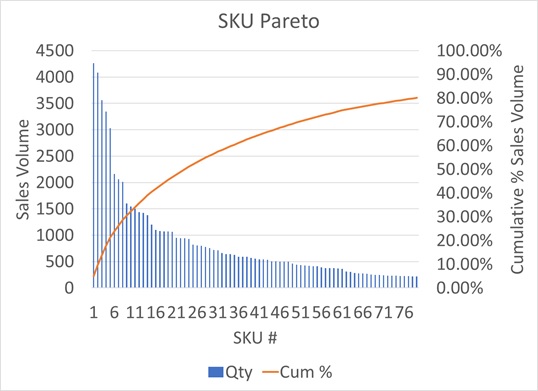
Company wanted to start an online distribution channel, but was unsure which of their 655 SKUs to put on it to start.  Turns out only 12% of their 655 SKUs (about 80 products) were making up 80% of their sales volume.
Blown up to show just the top 80% of SKUs: 80 of the 655 SKUs. Recommendation: Put those 80 products online first!

 
This company wanted to know in which category to focus their initial sales efforts when expanding to a new geography.  Looking at their historical sales, it appears that only 2 of their 6 categories drives 80% of their volume.

 
Here is a final example to show where Work-In-Progress (WIP) is located in a multi-step process.  The company needed to know where WIP was building up in order to assign more resources to the steps most in need.  Although the 80/20 rule is not perfectly followed here, it is obvious that about 4 of the fifteen steps in the process have the majority of the volume of WIP; a good place to begin assignment of additional efforts.

As can be seen, once data is “pareto-ed out,” it becomes visually obvious where the greatest opportunities lie.  It is a great idea to make Pareto part of your company’s every day lexicon, and get to charting!
Read this article and more on AJC’s blog, and sign up for our newsletter online at: http://andreajonesconsulting.com/blog.aspx

Thursday, February 16, 2017

The Power of Talking Face to Face

free clip art courtesy of https://clipartfest.com/
Last summer, I read the book “Your Brain at Work” by David Rock and took copious notes.  One note was “It is easier to work with people face-to-face; less uncertainty, clearer map."  (page 122)

In this day and age, we are so fortunate to be able to communicate in a myriad of ways: email, phone, texting, facetime, skype, shared chats, online forums, cloud-based tools, live networked meetings, and tons of others that I probably don’t even know about.  However, there is still something to be said for the face-to-face meeting.

As David Rock explained in his book, our brains want to be “certain” of things.  The more information we have, the more comfortable we become.  Imagine the thought of calling someone about a job possibility whom you have never met before on the phone.  The thought is daunting; what will they say to me?  Will they even listen?  What if they are mean, rude, obnoxious, or just plain disinterested?  Now consider calling someone whom you have met before face-to-face about a job possibility.  It is so much less stressful to think of how you will introduce yourself, probably by recalling whatever the situation was when you met them face-to-face, etc.  This is the certainty of which I speak.

A specific example of how using face time has benefited me personally.  As a consultant, I have always tried to meet with a prospective client in person for the first time.   When I was getting started, however, if the client requested a proposal, I would submit it over email then wait for a response.  For the most part this worked fine, but a few years ago it backfired. I had what I thought of as a great first meeting with a prospective client.  We talked for over two hours.  He gave me a tour of his facility we discussed opportunities for working together.  He asked for a proposal and I promised to deliver it via email on a certain date.

A few days after sending the proposal, this person had not responded.  I tried emailing again, calling, and even asking a mutual colleague to ask personally on my behalf.  He never answered either my email or calls, and was noncommittal to my colleague.  The stress and uncertainty was so frustrating that I brought up the issue with my professional group who made the recommendation that I start delivering proposals in person.  AHA moment for me.

In that particular case, I really had no recourse but to give up (I’m not the type to beat down doors!), but since then I have tried very hard to always deliver proposals in person.  Even when a client offers to have a phone meeting to discuss a proposal or important aspect of a project, I make every effort to meet in person when possible.  It is so much easier and more productive to ensure clear communication, that I have found it to be worth it.  And this is not limited to client/consultant relationships either.  When possible, face-to-face communication about important topics is best.

I’m not going to say that we should abandon all modern technology.  All I’m saying is that when possible, talk face-to-face, especially when the outcome is important.  You might be surprised by how well things turn out.


Read this article and more on AJC’s blog, and sign up for our newsletter online at: http://andreajonesconsulting.com/blog.aspx