Monday, February 27, 2017

Why Pareto Should Be Part of Your Lexicon

According to the Wikipedia, “A Pareto chart, named after Vilfredo Pareto, is a type of chart that contains both bars and a line graph, where individual values are represented in descending order by bars, and the cumulative total is represented by the line. A related Wikipedia article on the 80/20 Rule states that “It is a common rule of thumb in business; e.g., "80% of your sales come from 20% of your clients." 
AJC maintains that “Pareto” should be part of your lexicon.  And, despite that dictionary.com only has “Pareto” in as a noun or modifier, I often use the word “pareto” as a verb, as in “pareto that out”- meaning chart the data by category and plot it in order.  It is a terrific way to see where the “biggest fish” in your business are, as in what are the greatest few items to prioritize.
This way of considering items is helpful in so many ways as it can be used to indicate the greatest profit drivers, greatest volume of sales with which subset of SKUs, greatest defects, greatest WIP in a process, etc.
To illustrate, consider the following examples:
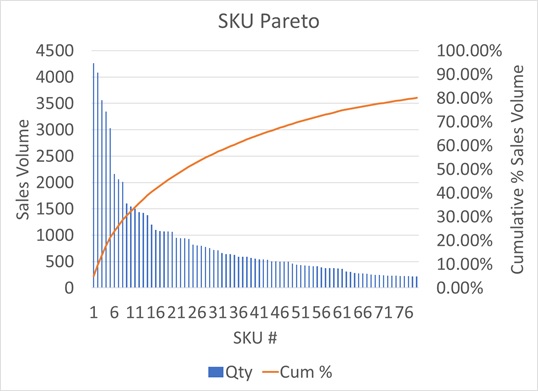
Company wanted to start an online distribution channel, but was unsure which of their 655 SKUs to put on it to start.  Turns out only 12% of their 655 SKUs (about 80 products) were making up 80% of their sales volume.
Blown up to show just the top 80% of SKUs: 80 of the 655 SKUs. Recommendation: Put those 80 products online first!

 
This company wanted to know in which category to focus their initial sales efforts when expanding to a new geography.  Looking at their historical sales, it appears that only 2 of their 6 categories drives 80% of their volume.

 
Here is a final example to show where Work-In-Progress (WIP) is located in a multi-step process.  The company needed to know where WIP was building up in order to assign more resources to the steps most in need.  Although the 80/20 rule is not perfectly followed here, it is obvious that about 4 of the fifteen steps in the process have the majority of the volume of WIP; a good place to begin assignment of additional efforts.

As can be seen, once data is “pareto-ed out,” it becomes visually obvious where the greatest opportunities lie.  It is a great idea to make Pareto part of your company’s every day lexicon, and get to charting!
Read this article and more on AJC’s blog, and sign up for our newsletter online at: http://andreajonesconsulting.com/blog.aspx

Thursday, February 16, 2017

The Power of Talking Face to Face

free clip art courtesy of https://clipartfest.com/
Last summer, I read the book “Your Brain at Work” by David Rock and took copious notes.  One note was “It is easier to work with people face-to-face; less uncertainty, clearer map."  (page 122)

In this day and age, we are so fortunate to be able to communicate in a myriad of ways: email, phone, texting, facetime, skype, shared chats, online forums, cloud-based tools, live networked meetings, and tons of others that I probably don’t even know about.  However, there is still something to be said for the face-to-face meeting.

As David Rock explained in his book, our brains want to be “certain” of things.  The more information we have, the more comfortable we become.  Imagine the thought of calling someone about a job possibility whom you have never met before on the phone.  The thought is daunting; what will they say to me?  Will they even listen?  What if they are mean, rude, obnoxious, or just plain disinterested?  Now consider calling someone whom you have met before face-to-face about a job possibility.  It is so much less stressful to think of how you will introduce yourself, probably by recalling whatever the situation was when you met them face-to-face, etc.  This is the certainty of which I speak.

A specific example of how using face time has benefited me personally.  As a consultant, I have always tried to meet with a prospective client in person for the first time.   When I was getting started, however, if the client requested a proposal, I would submit it over email then wait for a response.  For the most part this worked fine, but a few years ago it backfired. I had what I thought of as a great first meeting with a prospective client.  We talked for over two hours.  He gave me a tour of his facility we discussed opportunities for working together.  He asked for a proposal and I promised to deliver it via email on a certain date.

A few days after sending the proposal, this person had not responded.  I tried emailing again, calling, and even asking a mutual colleague to ask personally on my behalf.  He never answered either my email or calls, and was noncommittal to my colleague.  The stress and uncertainty was so frustrating that I brought up the issue with my professional group who made the recommendation that I start delivering proposals in person.  AHA moment for me.

In that particular case, I really had no recourse but to give up (I’m not the type to beat down doors!), but since then I have tried very hard to always deliver proposals in person.  Even when a client offers to have a phone meeting to discuss a proposal or important aspect of a project, I make every effort to meet in person when possible.  It is so much easier and more productive to ensure clear communication, that I have found it to be worth it.  And this is not limited to client/consultant relationships either.  When possible, face-to-face communication about important topics is best.

I’m not going to say that we should abandon all modern technology.  All I’m saying is that when possible, talk face-to-face, especially when the outcome is important.  You might be surprised by how well things turn out.


Read this article and more on AJC’s blog, and sign up for our newsletter online at: http://andreajonesconsulting.com/blog.aspx


Friday, February 10, 2017

A Crash Course in Process Mapping


One of my potential clients asked for a reference on how to do process mapping last week, so this article offers a crash course on the subject.  This will describe how AJC does Process Mapping.  Though the method is relatively standard, everyone will have different flavors or techniques.  Also, it should be noted that either Process or Value Stream Mapping can be done on something which already exists, usually starting with the Current State, then moving to a Future State if one wishes to improve or change things, or on something which does not yet exist and therefore is being designed.  In this case, the only map is the Future State, but the execution steps for mapping are the same.

First – is it a Process Map or a Value Stream Map?  The former can be used for any process.  The latter refers to the specific activities required to provide a particular product or service into the hands of the customer, which technically means it “goes all the way,” if you will, to when the customer receives whatever it is they are buying.  These tend to be higher level, as in the basic example below:
Figure 1: found on http://www.scaledagileframework.com/value-streams/
In a Process Map, however, the focus is on the specific flow of tasks and handoffs required to move from a particular starting point or trigger, to a particular end point.  The first thing to consider are what I call the “bookends” of the process.  As in, what is the start and what is the end of the process?  For example, in providing a Request for Quote, the start is the customer asking the company for a quote, and the end is the company delivering the quote to the customer.  Sounds pretty basic, yes?  The real trick is in articulating the particulars. 

How does the customer request a quote?  Email, phone, F2F, letter, online request, (does this still happen) fax?  Who at the company is the first one to receive the request?  Sales, Account Managers, Engineering, Administration, Help Desk?  What information is needed for a complete request?  Budget, quantity, timeline, design details, user requirements, sketches, drawings, CAD files, technical specifications, size, quality, dimensions, the list can go on and on, depending on the product or service.

Let’s take a quick step back before moving forward.  Process Maps are usually not created in a bubble.  Usually, and this tends to be very illuminating, they are performed with a group of people – all the people who do or will participate in the process in some way, including the suppliers of inputs or customers* of outputs of the process, when possible. 
*It may not be possible for the customer to participate, so people who deal directly with the customers should represent their needs.

Someone has to be designated as the Facilitator, often an outsider like a Consultant, but always someone who can remain objective about the process and will keep the group on focus.  It is a good idea to have a “Parking Lot” listed somewhere, for ideas or actions that come up which are not directly related to the process, and someone designated as “Scribe” (can be the Facilitator) who will note these and distribute them appropriately after the Mapping session.  The Scribe will also note any Waste, Ideas, Opportunities, or Enablers as they come up, for future reference.  Finally, materials – it is helpful to use a big roll of butcher paper (which can be purchased on Amazon.com) and multi-colored sticky notes for writing. 

After the first step of defining the bookends of the process, articulate “what comes next.”  The Facilitator will help the group identify the activity, who performs it, what information is needed to do it right the first time, what the specific output of that activity is, where relevant information is saved, and how it passes to the next step.  If there is a decision to be made, that is also described, and the resulting options are also mapped.  It is very important to drill down on exactly HOW the next group learns that they need to begin their work; a frequent problem that I have seen is that there is no systematic way of informing a downstream step that – guess what?! – it’s your turn!  Whether a system is used (ERP, MRP, cloud-based workflow or task management tool), or the handoff occurs via email, physical flow, or F2F conversation – it is CRITICAL that everyone agrees on how information or materials move from one step to the next.  As each activity is articulated, it is written on a sticky note and put up on the butcher paper.  You can designate what you want the sticky note colors to mean (some have yellow for activities, blue for decisions; others will color them by department).  No lines are drawn until the very end, because there is a pretty good chance things will move around before the session is over.
Figure 2: Current State Process Map using different colors representing different Departments - intentionally fuzzy
Now… here is the “Crash” part of this course.  For those of you who have participated in a Process Mapping session before, you realize that detailing out each activity is time consuming, sometimes confusing (“You do what? Why?  I didn’t know that!”), and all together pretty exhausting!  Lots of groups will do these as full-day events for a full week to go through Current State, Future State, Enablers, and even get started on the execution – commonly called a “Kaizen Event.”  This is terrific, if you have the ability to pull everyone off their day jobs for a week.  However, most of AJC’s clients can’t afford that kind of time away, and quite frankly, our prefrontal cortexes are pretty zapped after 4-5 hours of straight mapping.  I typically hold one or two 4-6 hour sessions (including lunch break) for the Current State, another one or two 4-6 hour sessions for the Future State, and a final review session for all the Enablers and assignment of actions.  Clients often prefer to space these sessions out over a few weeks, so they can still perform their duties in the meantime. 

Logistics for the sessions are up to you, but at the end, you should have a Current State Process Map for how things are done today – even if it is convoluted and complicated; a Future State Process Map which has cleaned up the process to get rid of all waste, confusion, misunderstanding, waiting, with improved flow, full utilization of the bottlenecks, etc. (for a newly designed Process, this is all you will have), and a list of “Enablers” which include all the things that need to happen in order to realize the Future State.  Sometimes these require a lot of investment – like automatically informing one group when a certain something has been done.  If you don’t yet have an automated workflow, this may be something for which a standardized work-around must be developed (i.e. always email the next step when you’re done with XYZ).  This should not be considered make-or-break, however, as we all know that you can go back to the process and revise it again once your company has outgrown the old method and/or has additional resources to invest in system upgrades.  The one piece of advice, of course, is to document the process flow BEFORE you buy some software that claims it will give you everything you need… make sure you know exactly what it is you need first!

So, what are some other things an objective Facilitator can do for you in Process Mapping besides facilitating the sessions and ensuring all relevant details are discussed, documented, and enablers/parking lot items written down and assigned?  Well, hopefully the objective Facilitator will also be your sanity check on why you do things a certain way, and help you whittle out all the unnecessary waste in your process.  If you’re serious about mapping, using a strong Facilitator can be a very useful way to get everyone on the same page and improve a process relatively quickly. 

Questions to the audience: Have you used Process Mapping as a tool?  If so, for what?  Did you have an outside Facilitator, or was this role performed by someone in house?  How did it go, regardless?  What are the best things a Facilitator has done to help your group?

Read this article and more on AJC’s blog, and sign up for our newsletter online at: http://andreajonesconsulting.com/blog.aspx


Thursday, February 2, 2017

Data: The Chicken or the Egg?


This is a common topic right now with AJC clients; do we need data first, or can we take action first?  In a metaphorical sense, is data the chicken or the egg?  Specifically, do we need data before we can make decisions, or do we decide first then collect data to see how our decisions are working out?

It has been said that “you can’t argue with the data!”  While this statement is not universally true, most people would agree that data is helpful in many cases, especially in a business sense.  The problem, however, is that we do not always have the required data at hand when we need to make decisions.  What we can consider up front is our well-informed hypothesis; what must we know to consider our decisions successful?  Whether it be to launch a new product or service offering, to demonstrate operational process improvement, institute an organizational incentive plan, make a channel platform decision, or whether to utilize a new service provider, we must identify what future success looks like, and compare the future reality state to this expectation.  Data is often a key contributor to this process, but is it the driver or the result?

To illustrate, let’s take a case study from a client project AJC worked on last year.  The problem statement was that Inside Sales was unable to keep up with exponential growth of incoming clients to be onboarded to the company’s service platform.  Good problem to have, for sure, but a 7x increase in one month was straining existing processes and causing extreme stress for staff.  After dealing with it for several months, the client asked AJC to help them figure out how to improve.  In this case, success was an improved process that could accommodate the higher client volume Inside Sales now had to accommodate. 

The first step was a Needs Assessment of Inside Sales and their supporting team members, and the first Chicken in the metaphoric case study.  This particular Needs Assessment included a Current State Process Map for each of the process steps within the overall value stream of bringing a new client onboard.  There were several low-hanging fruit opportunities highlighted for quick improvement, but one task in particular stuck out as a huge risk factor in the overall onboarding value stream.  This was a gating training session conducted on a one-on-one basis with the client. 

With only a handful of qualified trainers able to complete that task, it was likely that this was where the current onboarding process was breaking down the most.  At that time, we had no data, but the Needs Assessment articulated our hypothesis.  Next, we needed to collect data proving or disproving that this step was or was not a true process bottleneck.  Our Chicken was about to lay an Egg.

Luckily for us, this data was actually available to be mined in the form of historical timestamp information in the company’s workflow software.  Not every company will have this data right away, and if that is the case, this is when we take the time to collect as much data as possible to give us a good baseline of the current situation. *  In our study, we were able to calculate how many clients passed through each process step each week for over 20 weeks.  We were also able to show where all currently active clients were currently backlogged in the overall process. 
*Anecdotally, minimum sample size is often suggested to be 30 data points, though this is subject to many conditions; for the sake of getting anything done in this lifetime, my recommendation is to just go with as many as you can get, and stop at 30 if it is extremely painful to collect more!

Below is a chart depicting this data.  Actual values have been changed, but the trend is representative.
Figure 1: Volume Data by Process Step: Completion, Backlog; Cumulative
It was pretty obvious to everyone reviewing this chart that Step Four (the aforementioned one-to-one training step) was the bottleneck.  Not only did the second fewest client volume pass through this step on a weekly basis, but also the average and actual bottlenecks at this step dwarfed all the other steps.  We easily made our decision:  The Fourth Step had to be re-evaluated.  The next step was to figure out how, and continue measuring the flow and backlog at this step to prove that we were successful.  This was done by effectively doubling capacity at Step 4.  It actually represented a one-on-one client training session, which was easily transitioned to a two-on-one client to trainer ratio, immediately doubling capacity.


In the case study, we did not start with the data.  We had a problem statement that instigated a Needs Assessment which defined a hypothesis for the strongest driver of our probable cause.  We then gathered and analyzed data to prove the hypothesis and help us make an informed decision for action.  To follow our metaphor, the data was the “Egg.”  However, once we had the data, this Egg hatched into a new Chicken, which drove us to define strategies and implementation plans to improve this particular step, which became our new Egg.
Is Data the Chicken or the Egg?  The best answer truly is: both.
Read this article and more on AJC’s blog, and sign up for our newsletter online at: http://andreajonesconsulting.com/blog.aspx
If you sign up for our newsletter by February 10, we will send you a free copy of AJC’s Prioritization Matrix Template.

Sunday, January 29, 2017

Lean Thinking Article Blurb: How to Identify Waste in Your Organization

Image from "Let's Ban the Eight Waste" article referenced below

This is a good article; talks about challenges of objectively identifying the "waste" of untapped human potential; but also discusses that organizations should specifically identify what waste is to them, and gives "waste selection criteria" questions to help do that.

Thursday, January 26, 2017

To Managers of Enthusiastic Employees: Give Them a Chance

I often joke that if I could harness the energy of young children and sell it on e-Bay, I’d be the richest person in the world.  So why is it, then, that some managers squelch the enthusiasm of their employees who offer to drive internal improvement efforts?  Why not give them a chance, within reason, to prove themselves and their ideas?

The other week, I had the unique opportunity to meet with a young woman early in her career who was seeking advice for how to convince her manager that she should be able to expand the process improvement ideas she had implemented in her own work to the rest of the group.  She described that she had reduced a roughly 2-day manufacturing prep process down to 20 minutes, and believed that she could standardize her methods throughout the facility.  ‘Wow,’ I thought, ‘that sounds terrific!’

As our conversation unfolded, we discovered that she needed to collect some baseline data on the current process duration, then data on her method.  She then needed to translate that into the cost savings of saved time, which in a business that is growing like hers, could mean delaying the hire of additional employees and saving overhead expense.   We also discussed how she would need to estimate a basic timeline and hours for her implementation efforts, and how she would need to be able to do all of that while still completing her regular responsibilities.  She was willing to do the extra work to improve the process independent of additional compensation, so that should be a non-issue for her manager.

After spending an hour together and coming up with a plan, this woman went back to her workplace and proceeded to pitch her idea, complete with the need for data collection and implementation plan development, to her management.  She let me know how that went a week later.  Apparently while her work is exemplary and management is very happy with her performance, they do not want her to step outside her “box” (my word), and take on this extra challenge.

Sigh.

Do they not realize that companies pay consultants big bucks to do exactly what she wants to do, essentially for “free”?  As long as she is still completing her regular responsibilities on time and with the high level of quality with which she apparently already does her work, why shouldn’t she be given a chance to make this improvement impact?

Now I recognize that I do not know the entire scenario, context, or organizational culture involved.   However, this incident has brought up a few memories for me of the growing-more-distant-every-day-past J when I was just beginning my career.  I recall stepping “outside the box” in factory training and encouraging my small group to perform a skit, rather than just write on a flip-chart, when explaining how photolithography worked.  They were highly skeptical, but agreed to do it.  Later the Trainer told me that he had never before seen such a creative explanation, and went on to describe our skit as an example to all his future training sessions.  That was a good result.

Then there was the time when I offered to take on doing the ergonomic assessments for my Process Engineering group on top of my regular responsibilities.  My mentor thought that I couldn’t handle “more work” and discouraged me, but fortunately our mutual manager disagreed and allowed me to do it, which I did while easily managing workloads.  I was even selected to perform the assessment for the then Plant Manager (it took all of five minutes, and was the highlight of my career to date at that time!).  Again, ultimately a good result, but a bit more challenging to get there.


Along the way, however, there have been some other  managers who did not allow me to try new ideas or make changes.  They would say things like “No, you can’t do that,” “No, we won’t try that here,” “No, that’s too different,” “No, that will never work.”  Sometimes I never got a good reason, sometimes it made sense, but overall looking back, it seems to me that if companies are not just paying lip-service to wanting to improve, they would take full advantage of what an enthusiastic employee offers to do!  If the employee has the desire and the energy, harness that stuff right up; it’s worth more than anything which can be bought on e-Bay.

Let me tell you, Managers of Enthusiastic Employees:  If you find yourself consistently saying “No” to people who want to try new things, fewer and fewer good employees will be working for you sooner or later.  Give them a chance, even if it means allowing them to change the practices that you yourself put in place back in the day, because if you don’t – the good employees will eventually leave your company and do something for someone else who appreciates them. 


Read this article and more on AJC’s blog, and sign up for our newsletter online at: http://andreajonesconsulting.com/blog.aspx
If you sign up for our newsletter by February 10, we will send you a free copy of AJC’s Prioritization Matrix Template.

Wednesday, January 18, 2017

Why the “First Step” is a Needs Assessment

A "First Step" at the Great Wall of China (in 2005)

If you sign up for our newsletter by February 10, we will send you a free copy of AJC’s Prioritization Matrix Template referenced in our last blog post on Strategic Planning!


In honor of Dr. Martin Luther King, Jr., AJC submits that often a credible “First Step” is a Needs Assessment, which is how we begin many new client engagements.

Clients often ask what they will get out of a Needs Assessment, what exactly it is, and why do they need a Needs Assessment in the first place? 

To summarize what a client gets out of an AJC Needs Assessment, it provides the following deliverables:

1.       An articulated, documented, and prioritized “Laundry List” of improvement opportunities (“Issue Categories”) based on direct input from team members and leaders; objectively assessed for practicality and legitimacy

2.       (if survey scoring used): Numerical assignments for issue categories to aid in prioritization and comparison

3.       High-level implementation plans for improvement of the most important items on the list; aka the “Define” portion of a DMAIC project done, or initial “scoping” phase for other projects

The last two things a Needs Assessment provides are not true “deliverables” in the tangible sense of the word, but are instrumental in starting a new client engagement off on the right foot and establishing a positive foundation for continued work together.  These are:

1.       Rapport and trust built with client team members and consultant (team) as a foundation for continued work

2.       Quick immersion for an “outsider” to become an objective “insider” with respect to corporate needs and culture, helping provide appropriate and credible recommendations to improve the client’s actual situation

Each of these items provides different nuances of immediate and long term value to the client and overall success of the consulting engagement.  With these ends in mind, below is a description of what exactly an AJC Needs Assessment is, followed by a conclusion about why it is often “needed.”

At AJC, our Needs Assessments begin with a brief Kick-Off meeting with all the stakeholders.  We hold this introduction so everyone can meet face-to-face to discuss the goals and logistics of the Needs Assessment.  After reading the book “Your Brain at Work” by David Rock, one take-away (page 122) was that it is easier to work with people face-to-face; there is less uncertainty and a clearer mental map of what to expect.  It is extremely important to be introduced face-to-face in a proactive and transparent manner, and I strongly believe that it helps relieve many anxieties about hiring a “Consultant,” which often carries mixed connotation baggage.

Next is the “Data Collection” phase, which consists individual or focus group interviews with client team members; all the people working in or around the area being considered for improvement.  Though the number of questions are few, each interview typically lasts ~65 minutes on average.   We discuss what the team members do, frequency and durations for specific tasks/processes/activities, their pain points and ideas for improvement opportunities, and whether there are any areas of the business that they feel are unclear, and how that affects their work. 

As a side note, it is often helpful for the consultant to come into the Data Collection phase relatively “blind” to what is going on at the company; this ensures there are no pre-conceived notions, biases, or expectations about the information gathered.  AJC consultants are professionals, and we can still conduct an objective Needs Assessment for a company or group with which we have previous experience, but it is definitely ideal to come in cold.  This is why we recommend a Needs Assessment as part of our first engagement; the relationship will never be so new as in the beginning!

After all the data is collected, we aggregate the results, categorize them, and paraphrase all issues seen.  Individual comments are kept anonymous, but if there are enough interviewees, we provide an indication of the breadth and depth of each category (i.e. how many people commented on that category, and how frequently were unique statements about that category made).  This helps us with prioritization of the issue categories – items that are commented about frequently and by most people tend to be the heavy hitters.

At this point, AJC provides a Midstream Report in which the issue categories are documented with paraphrased descriptions in a first pass prioritization order.  This report is shared with the Leadership Team (as defined by the client), and we again meet face-to-face to discuss it.  This interim step has been added over our experience of conducting Needs Assessments (our own “Continuous Improvement!”) because we found that often the Consultant’s ideas about what is most important does not fully align with leadership.  There may be nuances about the business of which the consultant is not aware, and that were not brought up in conversations to date.  Also, Leadership may need certain areas to be considered first for strategic reasons, and the Consultant can often help describe the rationale for these priorities in our Final Report in a way that makes sense to the entire team. 

Once the Leadership team is aligned with the initial findings on basic priority, AJC submits the categories back out to the interviewees as a survey (optional, but recommended).  The survey is phrased for interviewees to assign prioritization weights to each issue category as it “What impact would resolution of these issue categories likely have on (Business Name) as a company?”  The question is phrased in this way to encourage respondents to think about the bigger picture and not just on their own personal pain points.  The survey also serves as validation to the interviewees that their comments were indeed head.

The Needs Assessment’s ultimate deliverable is then a Final Report which presents a prioritized list of Issue Categories based on results of data collection, discussions with leadership, and survey results.  It goes on to provide high-level Implementation Plans for resolving/improving the top 2-4 issues facing the company complete with action steps, estimated durations, and suggested accountability.  When possible, recommendations are also made for all issues presented in the Final Report, including references to other service providers if the issue itself is not part of AJC’s wheelhouse.  For example, issues around team building, HR, or sales training; AJC will recommend other resources who deal specifically with these needs.

As with the Midstream Report, the Final Report is presented in a face-to-face meeting with the Leadership team (and highly encouraged to be sent to all team members; optional “scrubbed” report available upon request).  At this meeting, we discuss the ultimate results, answer questions about the Implementation Plans, and prepare for Next Steps.  The Final Report Out  Meeting represents the “Define” step of a DMAIC (Define, Measure, Analyze, Implement, Control), or the “scoping” phase of other improvement projects.  Hopefully those Next Steps involve continuing with AJC in some way, but if not – the company now has an articulated and prioritized list of what to work on, and specific plans for how to improve the most important issue for them.

If the client would like to continue with AJC, there are three typical paths which can be followed:
First, AJC can be heavily involved in completing improvement work: there may be process mapping or kaizen sessions to facilitate, specific data to be collected and analyzed, processes to be designed or updated, or procedures to be documented or revised.  AJC can perform much of the heavy-lifting work associated with these activities, and often this is very helpful to busy clients who really want to realize the benefits of their Improvement Plans, but simply do not have the resources to dedicate toward time-consuming enabling work. 

Second, AJC can be moderately involved as an Advisor and Project Manager for improvement work; providing a certain amount of support and effort toward ultimate deliverables each week, but with the detailed completion of more time-consuming tasks often associated with documentation or data analysis/presentation allocated to client resources.  This is often the elected choice of budget-constrained clients. 

Third, AJC provides an “Accountability Model” to clients.  In this model, AJC provides light involvement, often in the form of in-person presence for weekly team meetings, then as an advisor or reviewer for work deliverables, but not independently creating any ultimate deliverables.  This option is recommended only when the client team has a specific person dedicated as a Project Manager as well as an execution team available since at this level, AJC is unable to provide the time needed to ensure minor roadblocks are overcome, or provide assistance in completing certain troublesome or “boring” documentation work.

In conclusion, why does any given company “need” a Needs Assessment in the first place?  The three main reasons are:

1.       Objectively “Define” or “Scope” prioritized improvements, with documented plans to realize results

2.       Build rapport, credibility, and trust in a short amount of time with an external resource that can catalyze or jump-start improvement work

3.       It represents taking the first step.  In the memorial words of Dr. Martin Luther King, Jr.:  You don't have to see the whole staircase, just take the first step.”
If you sign up for our newsletter by February 10, we will send you a free copy of AJC’s Prioritization Matrix Template referenced in our last blog post on Strategic Planning!